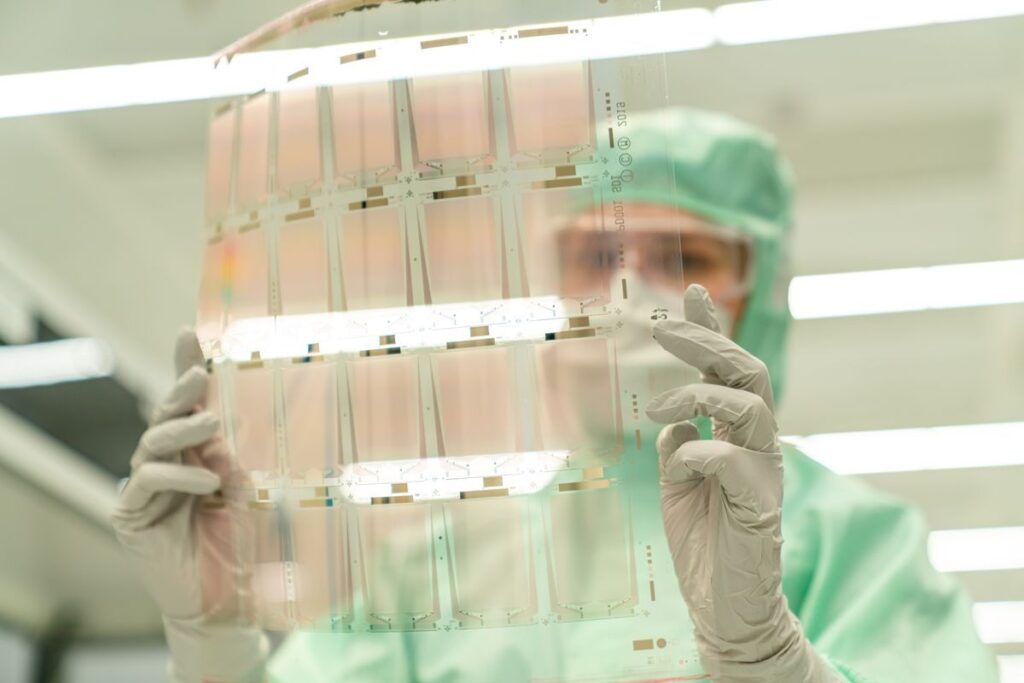
On October 30, news arrived from Changsha: by virtue of its specialized, refined, distinctive, and innovative development path and outstanding innovation capability in the photomask substrate field, Hunan Puzhao Information Materials Co., Ltd. (Puzhao Materials) was officially recognized as a national-level “Little Giant” enterprise. Earlier, in July this year, the company’s self-developed photomask substrate — the first 8.5th-generation high-precision product of its kind in China — rolled off the line in Changsha. Supported by a national key R&D program, this achievement filled a technological gap in China’s photomask substrate field and cracked the “chokepoint” problem for a core material of the flat-panel display industry chain.
Looking at the technical details, a photomask substrate is the master plate used for pattern transfer in flat-panel display and semiconductor manufacturing — often described as the “miniaturized negative” of chips and display panels, directly determining the process precision and yield of both. The 8.5th-generation product targets large-format photomask applications in flat-panel display: on a large glass sheet of 1.2 m × 1.4 m, the team had to grind the flatness from the original several hundred microns down to below 10 microns — equivalent to a difference between the highest and lowest points of no more than one-seventh of a human hair — while film-layer uniformity must be controlled at the nanometer level. The campaign on the first grinding process alone took nine months of continuous work, and the team later joined forces with the National Engineering Research Center for High-Efficiency Grinding at Hunan University to solve the pain point of micro-cracks in brittle, hard glass processing. On the industry side, two Changsha companies including Puzhao Materials hold a 70% share of China’s soda-glass photomask substrate market; the company is investing RMB 1.84 billion in a photomask substrate industrial base in the Xiangjiang New Area of Hunan, with phase two targeting high-end semiconductor photomask substrates, planned for production in the second half of 2027, and the two phases together expected to add about RMB 1.2 billion in annual output value at full capacity.
From the perspective of the industry landscape, the significance of this breakthrough goes beyond a single product. For a long time, the global high-generation photomask substrate market was highly monopolized by Japanese companies, with China’s localization rate extremely low — yet in 2025, China’s new-type display industry reached a total output value of over RMB 800 billion, and the country’s display panel capacity accounts for about 60% of the global market, ranking first worldwide. Should the international supply chain be disrupted, domestic panel fabs, wafer fabs, and photomask makers would face a “no rice to cook” situation. Puzhao’s “dual-track display + chip” layout — phase one taking on 8.5th-generation and below display photomask substrates, phase two advancing into high-end semiconductor substrates — marks a domestic-substitution path pushing from display materials into semiconductor materials, with the triple barriers of materials, equipment, and process being overcome one by one. Autonomous supply of upstream key links has become the mandatory question for holding the bottom line of supply-chain security.
For Junyi Microelectronics, the domestic-substitution depth of upstream core materials bears directly on the company’s entire hardware product line. Junyi’s touch-panel all-in-one machines rely on the display panel industry chain — the localization of photomask substrates contributes to supply stability and a flatter cost curve for panels, providing a more predictable material environment for touch-display products. The PCB and component supply behind the core boards J-3568/J-3576/J-3588, K-series edge-intelligent motherboards, and the industrial mini PC IPC-i5-1235U likewise benefits from the improved supply-chain resilience brought by autonomous control of upstream pan-semiconductor materials. The breakthrough of “invisible negative” products like photomask substrates and the computing-hardware track of edge-computing hosts 5G-EDGE-3399Pro/AI-BOX-3588 together form the depth of domestic hardware manufacturing — breakthroughs at both the upstream-material and downstream-system ends are what make for complete industrial security.
Source: https://finance.sina.com.cn/jjxw/2026-10-30/doc-iniwxzqa5666404.shtml (2026-10-30)