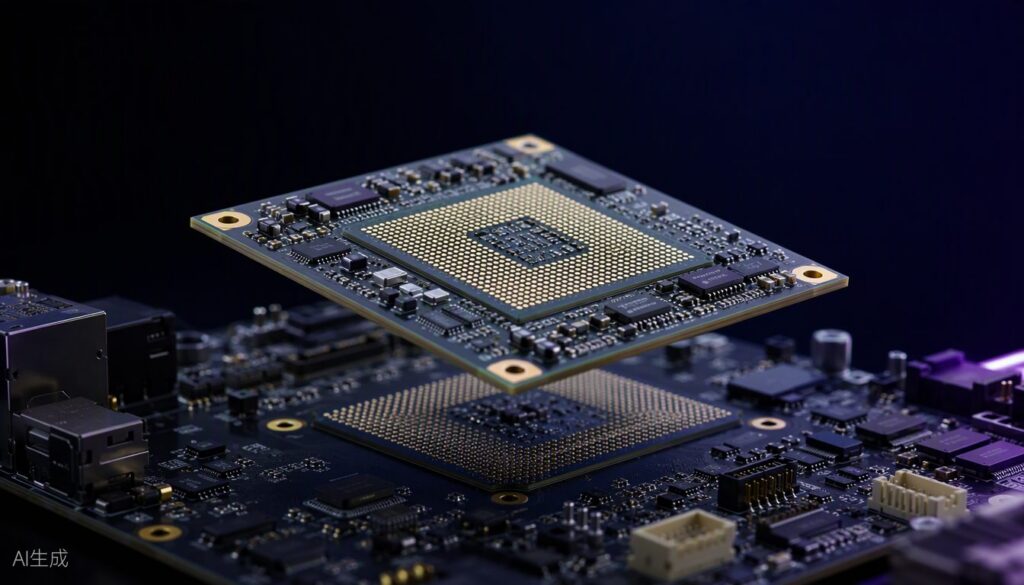
To address long-standing embedded-industry pain points such as frequent hardware iteration, difficult platform migration and constrained supply-chain choices, Forlinx Embedded has officially launched its UP5 standardized-package system-on-modules. The new FET3576-UP5/FET3576J-UP5 and FET3588-UP5/FET3588J-UP5 series offer a choice between Rockchip’s RK3576 and RK3588 processors, providing a flexible hardware foundation for industrial intelligence, edge computing and smart terminals.
UP5 is Forlinx’s universal package standard for SoMs: UP stands for Universal Package, while the number 5 denotes the compact 50 by 50 mm footprint. The modules use an LGA pad-array interface with 624 pins at a 1.25 mm ball pitch. Full pin compatibility within the package family means a carrier board only needs to be designed once; modules with different processors can then be swapped in directly, with no board redesign required.
The two module families cover different performance tiers. The FET3576-UP5 is built on the RK3576, an octa-core processor clocked at up to 2.2 GHz with a 6 TOPS NPU, triple-display output, up to 8K video decoding and a FlexBus parallel expansion interface. The FET3588-UP5 carries the flagship 8 nm RK3588 (four Cortex-A76 plus four Cortex-A55 cores), supporting quad-display output, 8K hardware encoding and decoding, and a new-generation 48 MP ISP. Industrial-grade variants operate from -40 to +85 degrees Celsius and come with a 10-to-15-year lifecycle supply commitment.
Standardizing the SoM package turns a processor swap from a redesign project into a component-selection decision: hardware designs become reusable, sourcing options multiply, and iteration risk falls significantly. For device makers, a standardized interface lets one carrier board span mainstream to flagship product lines; for the wider embedded industry, broader adoption of such standards can also ease selection pressure caused by chip supply volatility.
Source: Forlinx Embedded