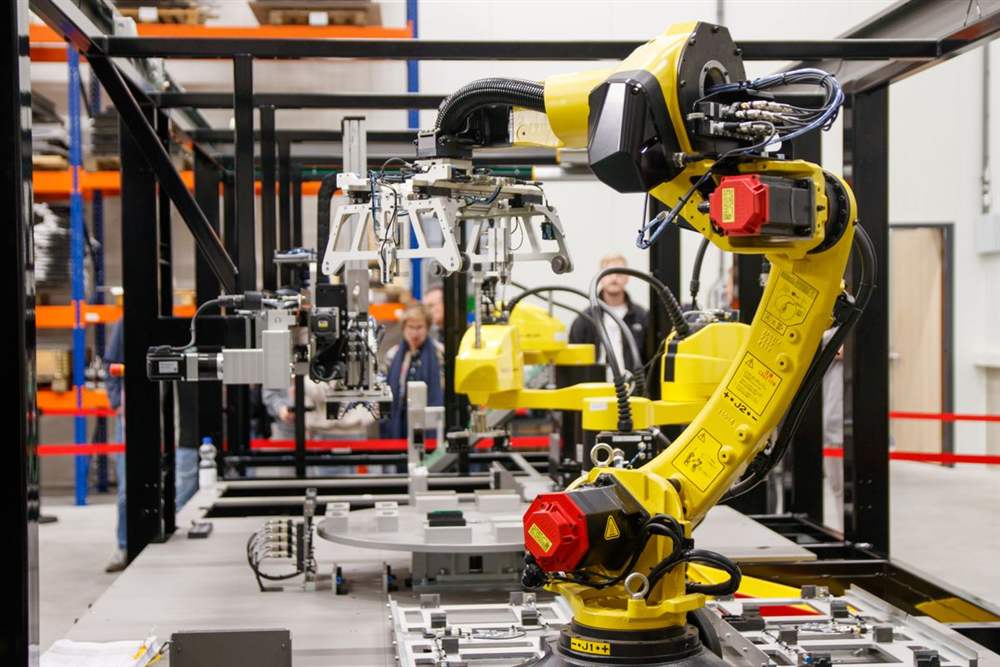
On October 19, the State Council Information Office held a press conference on accelerating sci-tech-driven commerce. Wei Wei, Director-General of the Science and Technology Department of the Ministry of Industry and Information Technology (MIIT), disclosed that by estimation China’s AI core industry exceeded RMB 1.2 trillion in 2025, with intelligent products and services spreading rapidly — AI phones entering “pockets”, intelligent connected vehicles running on the “roads”, and humanoid robots accelerating into “factories”. At the end of last year, MIIT together with the Ministry of Commerce and six other departments issued the Implementation Opinions on the “AI + Manufacturing” Special Action; over the past year the action has advanced in depth with positive results, and this “report card” has now been disclosed in a systematic manner for the first time.
The report card breaks down into five dimensions. First, scenario-driven application expansion: across 20 industries including steel, automotive and pharmaceuticals, more than 1,000 high-value application scenarios have been distilled under the “one industry, one map; one scenario, one file” model, 285 typical application cases have been published, over 5,000 enterprises have been brought together for supply-demand matchmaking, and AI application coverage among above-scale manufacturing enterprises has exceeded 30%. Second, consolidating the industrial foundation: the “model-data resonance” action has built more than 500 high-quality datasets across 20 key industrial fields, promoted over 100 industrial agents, and formulated hundreds of national and industry standards while leading the development of more than 70 international standards. Third, accelerating AI terminal products: national standards for terminal intelligence grading have been released across seven categories including smartphones, computers, TVs and glasses, and more than 100 million smart terminals of all kinds were shipped in the first half of 2026. Fourth, cultivating enterprises and talent: the number of AI enterprises exceeded 6,600 by the end of June. Fifth, optimizing the ecosystem: the AtomGit open-source community has been built alongside an RMB 60 billion national AI industry investment fund.
From the perspective of industry dynamics, “AI + manufacturing” is moving from single-point demonstrations to scaled deployment: coverage above 30% means AI is shifting from an exclusive feature of lighthouse factories to a standard capability of above-scale enterprises, and the combination of 5,000+ enterprises in supply-demand matchmaking with 100+ industrial agents signals that supply-side service capability is becoming systematic. Combined with the previously disclosed first-three-quarter industrial data — value-added output of above-scale industry up 5.3% year-on-year and high-tech manufacturing up 14.3% — new growth drivers powered by AI already contribute more than half of industrial growth. As “AI + manufacturing” translates from policy documents into datasets, standards and industrial funds, the AI transformation of manufacturing is acquiring replicable “infrastructure” properties.
For Junyi Microelectronics, the scaled landing of “AI + manufacturing” is both a market opportunity and a production tool. Junyi’s core boards J-3568/J-3576/J-3588 and K-series edge AI motherboards are precisely the computing carriers for edge-side sensing and control nodes in smart factories; edge computing hosts 5G-EDGE-3399Pro/AI-BOX-3588 support on-site deployment of AI inspection and predictive maintenance, while the compact industrial PC IPC-i5-1235U and touch-panel all-in-one machines directly serve human-machine interaction at production workstations. As the AI transformation of manufacturing moves from demonstration to popularization, demand for “edge computing + industrial interaction” hardware is shifting from project-based procurement to scaled purchasing.
Source: https://baijiahao.baidu.com/s?id=1879470948732784803 (2026-10-19)