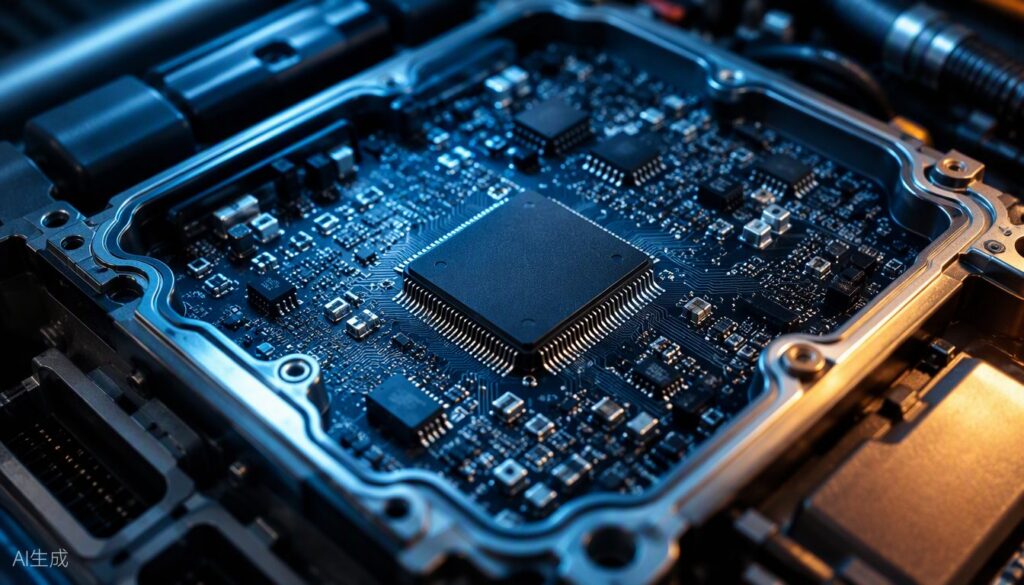
At the 6th Intelligent Automotive Chip Ecosystem Conference 2026 held on September 16, Liu Lin, senior marketing manager for Infineon’s automotive business and head of its RISC-V ecosystem in Greater China, made it clear that the company’s next-generation automotive microcontrollers will move entirely to the open RISC-V instruction set. The long-time global leader in automotive semiconductors is rebuilding its underlying technology roadmap around an open standard.
Automotive electronics accounted for about half of Infineon’s revenue in fiscal 2025, with Greater China contributing 38 percent of its global business. According to TechInsights data from April 2026, Infineon’s MCU market share has risen from 32.1 percent in 2025 to 36 percent. Its current MCU lineup follows a dual-architecture strategy: the ARM-based TRAVEO T2G series for the mid- to low-end, and the AURIX family (TC2/TC3/TC4) with proprietary TriCore cores for the mid- to high-end, widely used in domain controllers, powertrains and battery management systems. For the next generation, resources will be concentrated on RISC-V.
Ecosystem preparation has been underway for some time: Infineon completed its compiler, debugger and virtual-prototype toolchain layout in 2024, extended it to the operating-system layer through 2025 and 2026 with AUTOSAR adaptation alongside Vector, Neusoft Reach and Puhua, and advanced cooperation with open-source communities such as FreeRTOS, Zephyr and NuttX. The DRIVECORE RISC-V virtual-prototype pre-integrated evaluation kit released in March 2026 is already being used by some domestic OEMs and Tier-1 suppliers for early evaluation.
Domestic RISC-V automotive chips are accelerating in parallel: the DF30 multi-core engine-control chip, jointly developed by Dongfeng and China Information and Communication Technologies Group, is built on a RISC-V architecture with a domestic 40 nm automotive-grade process and ASIL-D functional safety. It has completed validation on models including the Dongfeng eπ007, M-Hero M817 and Aeolus Haohan, debuts in an engine ECU, and is scheduled for scaled production in 2026. With standardization and production validation advancing together, RISC-V is moving from an alternative to a mainstream architecture in automotive-grade chips, a shift worth tracking for the embedded supply chain as a whole.
Source: iFeng Auto, Gasgoo