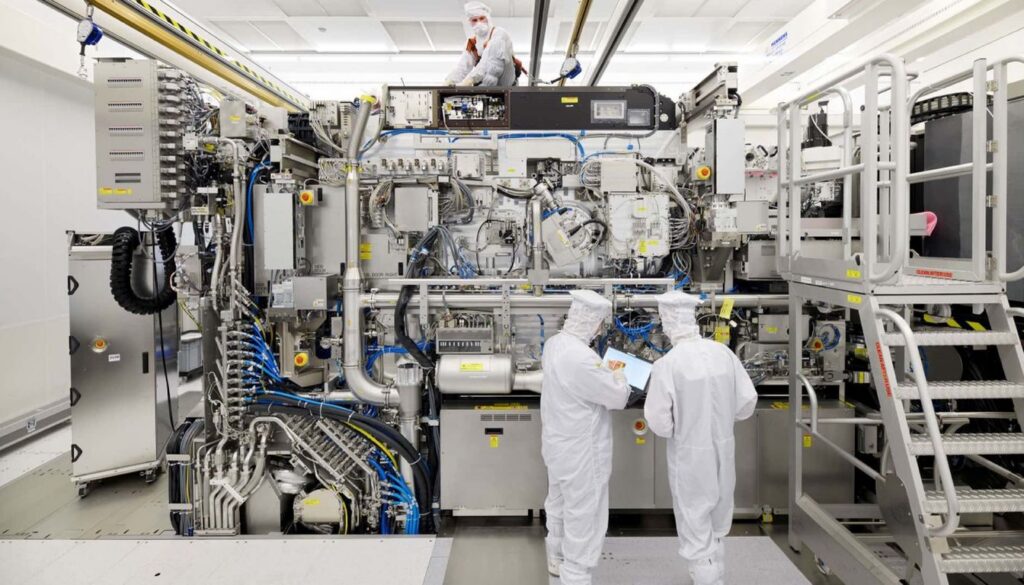
At the 26th China International Industry Fair, Langdao Suiyan (Shanghai) Technology unveiled for the first time a prototype extreme ultraviolet (EUV) light source system. This represents the most advanced publicly visible domestic EUV light source prototype to date, regarded by the industry as the “heart” of high-end lithography equipment. According to on-site staff, the system achieves a 90% localization rate, with the vast majority of core components developed independently.
EUV light sources are critical equipment for manufacturing chips at 7nm and below advanced process nodes, a domain long monopolized by Dutch company ASML. The debut of a domestic EUV light source prototype signifies substantive progress in China’s efforts to overcome semiconductor manufacturing bottlenecks. Langdao Suiyan’s website shows that the high-power FlintMicro-LPP EUV light source series has completed proof-of-concept validation, while the low-power FlintNano-LPP series is already in the productization stage.
According to technical parameters published on the company website, the FlintNano LPP-OXXO features a 1000W drive laser power, 1-20kHz laser frequency, conversion efficiency greater than 2%, EUV energy exceeding 15W, and continuous operation time over 100 hours. Founded in 2024 and building on research results from Tsinghua University’s Gas Discharge Plasma Laboratory, Langdao Suiyan focuses on LPP-EUV lithography light source technology and has completed Series A financing with investors including Woyan Capital and SMIC Venture Capital.
From the perspective of embedded and industrial control chip industries, the localization of EUV technology will indirectly benefit domestic chip design companies. Rockchip’s RK3588 and RK3576 currently utilize 8nm process technology, and domestic EUV capabilities will provide supply chain security assurance as these products evolve toward more advanced nodes. For embedded solution providers like Junyi Microelectronics that build on domestic chips, improved upstream manufacturing capacity translates to more stable production forecasts and more manageable supply risks.
Furthermore, the EUV light source breakthrough will drive development across supporting industries including photoresists, optical components, and precision machinery, creating a clustering effect for domestic semiconductor equipment. During the 15th Five-Year Plan period, as domestic EUV technology continues to iterate, China’s semiconductor industry is expected to progress from a “strong design, weak manufacturing” pattern toward more balanced development across the entire value chain.
Source: IT Home / Jiefang Daily