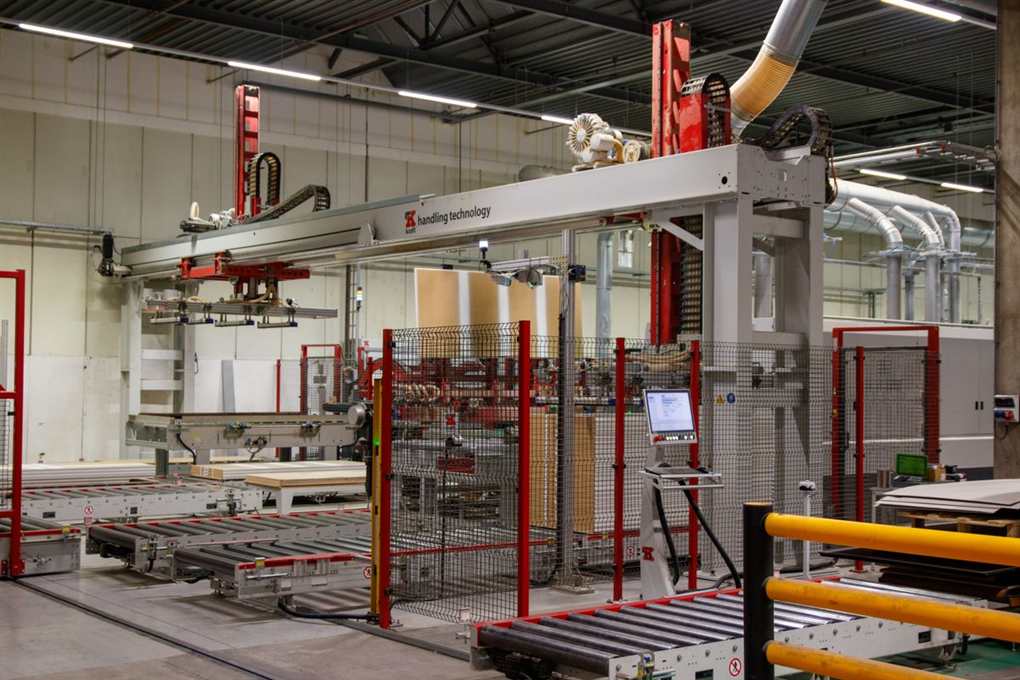
On October 26, China’s Ministry of Industry and Information Technology (MIIT) issued a notice publicizing the proposed 2026 pilot-level (“Linghang”, or navigation/leading-grade) smart factory cultivation list, with 34 factories selected, including Xiaomi’s “AI-driven agile-manufacturing premium new-energy-vehicle super smart factory”. The public comment window runs from October 27 to November 2, 2026, under the Notice on Carrying Out the 2026 Smart Factory Gradient Cultivation Action (MIIT document No. 343), organized by MIIT’s Equipment Industry Division I. Regionally, Jiangsu Province leads with six entries; ZTE (Nanjing) was selected for its “multi-agent-driven dual-flow autonomous-circulation smart factory for communication and computing equipment”, making Nanjing the only city in the province with national pilot-level selections in two consecutive years.
Smart factories are the main carrier of intelligent manufacturing and the main battlefield of digital and intelligent transformation. China currently runs a four-tier gradient cultivation system—basic, advanced, excellent and pilot/leading levels: basic and advanced tiers lay digital foundations, the excellent tier achieves full-process optimization, and the pilot tier explores future manufacturing models. The naming of selected projects clearly reflects the trend—”AI-driven”, “multi-agent autonomous circulation” and “dual-flow” signal that large-model and agent technologies are moving from proof of concept into the reorganization of production-line operations. As of the announcement, China had cumulatively built more than 13,000 advanced-level and over 500 excellent-level smart factories; the 2026 excellent-level list publicized in the same week proposes 253 factories nationwide, with Jiangsu taking 39 for the top regional count—the gradient pyramid is visibly scaling tier by tier.
Seen from the industry landscape, the signal value of the pilot-level list outweighs the list itself. First, automotive and electronics manufacturing are the densest sectors at the pyramid’s top, reflecting how large-scale discrete manufacturing feels the most acute pressure for AI-based scheduling, quality closed-loops and flexible line changes. Second, agent technology appears for the first time as the core term in national-level project names, meaning “AI entering the production-organization layer” now carries official endorsement, and the demonstration effect will propagate along supply chains to smaller manufacturers. Third, the four-tier system maps to differentiated fiscal, standards and evaluation resources; manufacturers’ upgrade path is shifting from “one-off projects” to “graded progression”, pushing capabilities such as machine-vision inspection, AGV scheduling, digital-twin synchronization and data closed-loops down the tiers.
The tiered advance of smart factories is creating deterministic demand for edge computing hardware: multi-agent coordination and line-level AI inference both require compute to sink to the shop floor rather than rely wholly on the cloud. Junyi Microelectronics’ product system fits this precisely—the J-3568/J-3576/J-3588 core boards serve as line controllers and vision-processing mains handling device interconnection and real-time inference; K-series edge AI boards provide the local AI compute base for inspection stations; the 5G-EDGE-3399Pro and AI-BOX-3588 edge computing hosts suit workshop-level data aggregation, model inference and protocol conversion; the IPC-i5-1235U industrial mini PC, with x86 compatibility, can directly host MES terminals and data-acquisition gateways; and touch-panel all-in-ones serve human-machine interaction and production dashboards. As the demonstration effect of pilot- and excellent-level factories spreads, scaled procurement of similar edge hardware by advanced-level projects will keep accelerating.
Source: https://news.qq.com/rain/a/20261027A079BL00 (October 27, 2026)